
The Short Answer
Which is better: free or paid real estate leads?
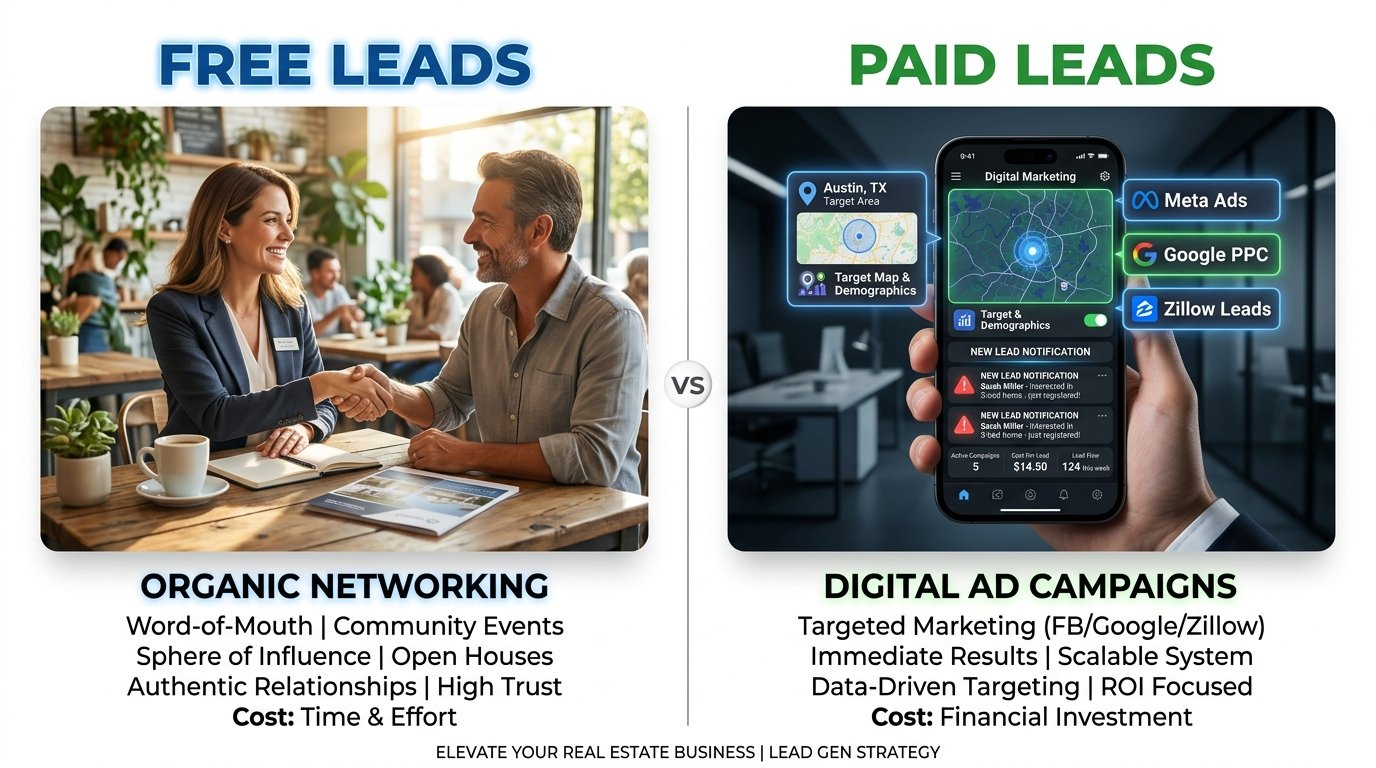
Neither is inherently “better.” Free leads cost you time and consistency. Paid leads cost you money and require discipline. The most successful agents in 2026 use both — free and earned leads as their foundation and paid leads to fill gaps when they need volume quickly.
The smartest strategy? Start with free and earned leads to build an asset you own. Use pay-at-closing and paid leads to supplement volume. And always prioritize leads that give you the highest take-home commission after broker splits and follow-up time.
What Are “Free” and “Paid” Real Estate Leads? A Clear Definition
Paid real estate leads are acquired through direct financial investment — subscription fees, pay-per-lead costs, or pay-at-closing referral fees. These are leads you buy access to through platforms like Zillow, Realtor.com, or referral networks.
Free real estate leads are earned through networking, referrals, organic search, and personal outreach with no per-lead cost. These come from your sphere of influence, past clients, open houses, Google Business Profile, SEO content, and direct outreach.
Key Insight: Neither is truly “free.” One costs money. The other costs time. The question is which resource you have more of — and which investment gives you the best return.
Paid Real Estate Leads — The Money Model
- Subscription-based leads (Zillow Premier Agent, Realtor.com) — you pay a recurring fee for access to leads
- Pay-per-lead model — you pay a fixed amount (CPL) for each lead, regardless of conversion
- Pay-at-closing/pay-per-close model — you pay a referral fee only when a transaction closes
- Pay-per-click advertising (Google Ads and Facebook Ads) — you pay for clicks or impressions
Free Real Estate Leads — The Time Model
- Sphere of influence — friends, family, past clients, and professional network
- Referrals from past clients — word-of-mouth recommendations
- Google Business Profile optimization — free local SEO visibility
- SEO and content marketing — blog posts, market reports, neighborhood guides
- Open houses and community events — in-person connections
- FSBO and expired listing outreach — direct contact with motivated sellers
- Social media — organic posts on Facebook, Instagram, LinkedIn, TikTok
The Complete Cost Comparison
The “Free” Fallacy — What Free Actually Costs You
Key Insight: Free leads are best understood as earned leads that compound over time. “Free” means no per-lead cost, not no effort. You’re trading cash for time, consistency, and a reputation that does the selling for you.
The Time Tax
Free leads require qualification hours. When you spend mornings chasing unqualified leads, you consume time that could build a sustainable business. The question isn’t “Is this free?” but “Is this the best use of my time?”
The Quality Gap
When sellers fill out a free home valuation form in 2026, many of them are not serious sellers. They are just looking for a quick report, not a conversation, an appointment, or a listing consultation. This means you spend time qualifying leads that were never serious to begin with.
The Opportunity Cost
Time chasing free leads = time not spent building compounding lead systems. A paid-lead approach is a faucet you pay to keep running. An earned-lead system is a well you dig once. The well produces for years with minimal maintenance. The faucet stops the moment you stop paying.
The Financial Reality of Paid Leads
| Lead Source | Cost Per Lead (CPL) | Average Conversion Rate |
| Zillow Premier Agent | $50-$150 | 1-3% |
| Realtor.com | $15-$40 | 2-4% |
| Google PPC | $102.50 median | 3.80% |
| Facebook Ads | $1.05 CPC | 2.90% |
| Referrals | $0 | 15-25% |
Key Fact: The average cost per portal lead hit $181 in 2026 — up 1,107% since 2015 — with a national conversion rate of 0.4%. This means you’re paying significantly more for leads that convert significantly less than they did a decade ago.
Key Fact: Real estate PPC cost per click has climbed to a median of $4.88 across 124 US cities, with a median cost per lead of $102.50 and a median conversion rate of 4.75%. While search leads cost more, they tend to be higher quality.
Key Fact: The average cost to acquire a lead in real estate now sits at $46.35 across all channels. Search leads cost more ($58.50) but tend to be higher quality, while display and social leads come cheaper ($38.20) but require more nurturing.
The Pay-at-Closing Alternative — No Upfront Cost, Back-End Fee
Real estate pay-at-closing lead companies provide access to potential clients without the upfront costs typically associated with traditional lead-generation services. Agents only pay for leads that result in successful transactions, minimizing risk and maximizing return on investment.
Key Fact: A referral fee is typically around 25% of the receiving agent’s commission, with deals ranging from 25% to 35% depending on lead quality, property price, market conditions, and the relationship between agents.
The Math Example:
Based on median U.S. home price of $410,800 (Q2 2025, U.S. Census/HUD data via FRED):
| Scenario | Commission | Referral Fee | Agent Net (before broker split) |
| Pay-at-close: $410,800 home, 3% commission | $12,324 | 35% = $4,313 | $8,011 |
| Owned leads: $410,800 home, 3% commission | $12,324 | $0 | $12,324 (before ad costs) |
The takeaway: Pay-at-closing reduces upfront risk but the backend fee can be expensive once you factor in referral splits, broker split, and time spent converting leads that never close.
Lead Quality: The Deciding Factor
What Makes a Lead “High-Intent”?
High-intent signals:
- Buyer has pre-approval for financing
- Seller has a timeline (relocation, life event)
- Lead has engaged with multiple content pieces
- Lead is asking specific questions (price, timeline, process)
- Lead responds quickly to contact attempts
- Lead has provided accurate contact information
Low-intent signals:
- Browsing without timeline
- Requesting “free home valuation” without interest in an appointment
- Asking general questions with no follow-up
- Not responding to contact attempts
- Provides incomplete or inaccurate contact information
Key Fact: Agents using speed-to-lead automation on Zillow leads often report conversion rates 50-100% above the industry average because they consistently hit the 5-minute response window.
Key Fact: 62% of real estate inquiries are submitted outside traditional business hours — evenings and weekends are peak inquiry times. Without an automated speed-to-lead system, you will miss the majority of leads you paid for.
The 5-Minute Rule
Contact within 5 minutes makes you 21 times more likely to convert that lead. Research from Inman’s 2025 survey shows that the average agent takes 917 minutes — over 15 hours — to respond to a new portal lead.
Key Fact: 78% of buyers work with the first agent who responds. If you’re not responding within minutes, you’re losing business to agents who do.
Free Real Estate Lead Sources That Actually Work
Google Business Profile — The Free Local SEO Engine
- Post market updates every few days
- Add new listings immediately
- Respond to reviews within 24 hours
- Keep your profile complete with photos, services, and business hours
Result: Agents doing this consistently report 10-15 organic leads monthly at zero cost. Google Business Profile is the single most effective free lead source available to agents.
Your Sphere of Influence — Your Most Valuable Asset
- 38% of sellers found their agent through a referral from friends or family
- 20% of business from previous clients
- Call 5-10 past clients weekly — check in, share market updates, ask how they’re doing
- Send handwritten notes, holiday cards, and birthday greetings
Key Fact: Your sphere costs nothing to maintain beyond your time and attention. It’s the highest-converting lead source available.
Referrals — The Trust Pathway
- Referrals convert at 15-25% — the highest of any source
- The most profitable “free” strategy — zero acquisition cost, highest conversion rate
- Each referral can lead to multiple referrals (the referral chain effect)
Key Fact: A single happy client can generate 3-5 referrals over their lifetime. This compounding effect is what builds sustainable businesses.
Open Houses — Free Access to Buyers and Neighbors
- Collect sign-in sheet contacts (name, phone, email, timeline)
- Follow up within 24 hours
- Neighbors are often curious about their own home values
- Prepare neighborhood market reports to share with visitors
Key Fact: Open houses generate qualified buyer leads and neighborhood connections — all at zero cost beyond your time.
SEO and Blog Content — The Well You Dig Once
- Takes 6-12 months to gain traction
- Generates leads for years after creation
- Cost: time to create; value: compounding asset
- Focus on local market reports, neighborhood guides, and buyer/seller FAQs
Key Fact: Real estate companies with active blogs generate 5.4x more leads than those without content marketing.
FSBO and Expired Listings — Direct Outreach Opportunity
- Contact 10-15 FSBOs/expired listings weekly
- Offer free market analysis or staging consultation
- Provide specific value (recent sales data, buyer database access)
- Be persistent but respectful — follow up over time
Key Fact: Expired listings are posting a 44% list rate and a 20.7% sold rate — making them the highest-performing lead source of 2026 by a significant margin.
Paid Real Estate Lead Sources: What You’re Actually Buying
Portal Leads — Zillow, Realtor.com, and the Aggregators
Zillow Premier Agent:
- Cost: $50-$150 per lead depending on market
- Model: Subscription-based; leads shared with 3-5 other agents
- Strength: Trusted brand, high volume, immediate lead flow
- Weakness: You’re renting access — stop paying, stop receiving. Three years ago, Zillow Premier Agent leads converted at 10 to 15%. That math doesn’t work anymore. The same spend is producing 3 to 5% conversion rates in most markets — sometimes lower.
Zillow Flex — Performance-Based Program:
- Cost: No upfront cost; success fee at close (15-40%)
- Selective access: You need a strong track record to qualify
- Leads are often exclusive — no competition
- Requires: Fast response, strong conversion discipline, operational rigor
- Cost: $15-$40 per lead depending on market
- Speed-to-lead critical — favors those with fast response
- Strong national scale
- Exclusive: When you pay for leads on Realtor.com, those leads are exclusive to you
Top Pay-at-Closing Providers
| Provider | Best For | Referral Fee | Key Feature |
| PayAtClosingRealEstateLeads.us | Agents wanting no-upfront-cost leads | Varies by location | Exclusive leads, pay only at closing, personalized service |
| Clever Real Estate | Streamlined platform | 1.5% listing agent commission | Agent-matching system, pre-qualified leads |
| Zillow Preferred | Course & coaching | 15-40% of commission | Performance-based incentives, training materials |
| SOLD.com | Performance-based lead assignment | ~30% of commission | Lead management dashboard, qualified sellers |
| HomeLight | Data-driven lead matching | ~33% of commission | Both buyer and seller leads, mobile app |
| Agent Pronto | Receiving leads via text | 25-35% of commission | Fast lead connections, agent-agent referrals |
| UpNest | Leveraging technology | ~30% of commission | Sellers compare multiple agents |
| ReferralExchange | Experienced agents | Varies | High-intent leads, performance monitoring |
Key Fact: Pay-at-closing companies often require agents to meet specific performance criteria. If conversion rates dip too low, agents may get kicked out of the program entirely.
What Are Pay-at-Closing Real Estate Leads? The Complete Guide
Pay-at-closing real estate leads are referral-based leads where agents pay a fee (typically 25-40% of commission) only when a transaction successfully closes. There is no upfront cost to access these leads, making them a low-risk option for agents without large marketing budgets.
How Pay-at-Closing Lead Models Work
- Third-party company runs marketing and captures the lead
- They route leads to agents who join their program
- You pay a referral fee out of your commission when the deal closes
- You must follow their follow-up rules to keep getting leads
- Some providers require specific response times, lead management practices, or CRM integration
Pros and Cons of Pay-at-Closing Leads
Pros:
- No upfront cost — zero risk to start
- Pre-screened leads — often phone-verified or qualified
- Easy way to fill your pipeline with minimal financial commitment
- Great for new agents with limited budgets
- Aligns incentives — you pay only when you succeed
Cons:
- Referral fees reduce net income (25-35% of commission)
- Highly competitive — agents must respond in seconds, not minutes
- Leads are often shared in larger metro areas
- You don’t own the lead data — stop working with the platform, stop receiving leads
- Some programs have strict performance requirements
Key Fact: Some pay-at-closing providers include terms where they’d continue to receive referral fees for any future transactions involving the lead for a specified amount of time.
Who Owns the Lead? The Critical Question Most Agents Ignore
The “Rent” Model (Paid/Pay-at-Closing)
| Factor | What It Means |
| Who owns the data? | The vendor owns the lead source, routing, and follow-up rules |
| What happens when you leave? | You lose complete access to leads you’ve nurtured |
| Can you sell your database? | No — it’s not your asset |
| Economics | You pay forever; no compounding value |
| Business equity | Minimal — buyers don’t value rented leads |
The “Own” Model (Free/Earned Leads)
| Factor | What It Means |
| Who owns the data? | You do — every contact lives in your CRM |
| What happens when you leave? | Your database stays with you |
| Can you sell your business? | Yes — buyers pay for your database, brand, and systems |
| Economics | Builds compounding value over time |
| Business equity | Maximum — your database is your most valuable asset |
Key Insight: Bought leads are an expense that resets every month. An earned-lead system is an asset that appreciates. If you want a business you can actually sell someday, you need to own your database.
Building a Balanced Lead Generation System
Why the Most Successful Agents Use Both
- Free and earned leads as the foundation — you own the asset, it compounds over time, it builds business equity
- Paid leads to fill gaps — when you need volume quickly in a specific niche or market
- Pay-at-closing for opportunistic volume — while building your own database, these provide immediate deal flow with no upfront cost
When to Scale Paid Leads (and When to Pull Back)
Scale paid when:
- You have capacity to follow up within 5 minutes
- You can sustain 3-6 months to see ROI
- You need volume in a specific market or niche
- You have a CRM and follow-up system in place
- You have an inside sales agent (ISA) or team to manage volume
Pull back when:
- Leads aren’t converting (check your response time first)
- Referral fees eat too much margin
- You have enough owned lead flow
- Your conversion rates drop below acceptable thresholds
The “Listings First” Principle
Listings compound; buyer leads don’t. One listing generates 3-5 buyer leads organically through sign calls, open houses, and online inquiries.
Why listings matter more:
- Listings create visibility (yard signs, online presence)
- Listings generate buyer inquiries
- Listings establish local authority
- Listings lead to referrals
Converting Leads Into Clients — The Post-Lead Strategy
The Role of CRM in Lead Management
- Track every lead source
- Log all contact attempts
- Set follow-up reminders
- Measure conversion rates by source
- Tag leads by intent level (hot, warm, cold)
- Score leads based on engagement and response
Drip Campaigns and Long-Term Nurturing
Most leads do not convert immediately. Top teams maintain engagement by providing leads with valuable resources:
- Homebuying guides and checklists
- Home-selling guides and timeline
- Market reports with local data
- Video breakdowns of market conditions
- Neighborhood and community information
- Seasonal home maintenance tips
Key Fact: Email marketing open rates in real estate are strong at 38.4%, thanks to market report subject lines that attract attention.
Key KPIs to Track
| Metric | What to Measure | Why It Matters |
| Cost Per Lead (CPL) | Total lead cost / number of leads | Efficiency of acquisition |
| Conversion Rate | Leads closed / total leads acquired | Quality of leads and follow-up |
| Cost Per Closing | Total spend / number of closed deals | True ROI of lead source |
| Lead Response Time | Time from inquiry to first contact | Critical conversion factor |
| ROI | Profit generated / marketing cost | Ultimate measure of success |
| Lead Velocity | New leads entering pipeline per month | Pipeline health indicator |
Free vs Paid Real Estate Leads: Which Should You Choose?
The right choice depends on your business stage and goals. New agents with limited budgets should start with free and earned leads plus one or two pay-at-closing referral networks. Established agents with marketing budgets should build owned systems as the foundation and use paid leads to supplement volume. Most successful agents use a hybrid approach, not an either/or decision.
Decision Matrix: If You Are…
| Your Situation | Best First Move | Why |
| New agent with no budget | Start with Agent Pronto + build Google Business Profile | Accessible referral entry point + free local SEO foundation |
| Solo agent focused on listings | Use UpNest + FSBO outreach | Creates seller opportunities + direct outreach control |
| Established agent with strong close history | Layer HomeLight, ReferralExchange, and owned lead systems | Referral networks supplement pipeline; owned data protects margin |
| Response-heavy team with ISA support | Test Zillow Flex + Realtor.com OpCity | These models reward fast coverage and disciplined operations |
| Agent who hates giving away commission | Prioritize SEO and self-sourced outreach | Fixed software spend scales better than referral fees |
Real Agent Stories — What’s Actually Working
Example 1: New Agent Success with Hybrid Approach
A newly licensed agent with no marketing budget started by:
- Using Agent Pronto for initial deal flow
- Building their Google Business Profile with consistent posts and reviews
- Hosting open houses every weekend
- Contacting 10 FSBOs weekly
Result: Within 6 months, organic leads equaled referral lead volume. Within 12 months, owned leads surpassed paid leads as their primary source.
Example 2: Team Scaling with Paid Leads
A 5-agent team in a competitive metro allocated their marketing budget strategically:
- 40% to Zillow Premier Agent and Realtor.com for reliable volume
- 20% to Google PPC for high-intent search leads
- Maintained referrals and sphere of influence as their foundation
- Used an ISA to manage speed-to-lead response
Result: 3x increase in conversion rates through the hybrid approach. Annual ROI of 350% on paid lead investment.
Example 3: The Cost of Slow Response
An agent spending $2,000/month on Zillow leads consistently responded within 30-60 minutes. After implementing speed-to-lead automation (under 5 minutes), conversion rates increased 80% within 90 days — without changing anything else.
The Future of Lead Generation — AI Search and Your Digital Footprint
AI Overviews and E-E-A-T in 2026
Traditional SEO was about being the best answer on a single page. AI overviews now pull from multiple trusted sources to synthesize an answer. You’re no longer trying to be the best answer on a page. You’re trying to be a trusted source that the AI will reference to build an answer.
What this means for agents:
- Build authority across multiple channels, not just your website
- Get mentioned in industry publications
- Accumulate genuine reviews and testimonials
- Create content that AI can confidently cite
Building Your Digital Footprint
One website is not enough. Agents need a footprint across multiple independent domains:
- Reviews on Google, Facebook, Zillow, Realtor.com
- Published articles on industry sites
- Content with your name attached in multiple places
- Active social media presence with consistent posting
- Guest contributions to local media
Key Insight: They can only find you if there’s content out there about you. AI search relies on your digital footprint across the web.
Frequently Asked Questions About Free vs Paid Real Estate Leads
What is the average cost of paid real estate leads?
Paid real estate leads cost between $15 and $150 per lead depending on the source. Zillow leads average $50-150. Realtor.com $15-40. Google PPC has a median CPL of $102.50. Facebook CPC averages $1.05. However, cost per lead is only meaningful when paired with conversion data — a Facebook lead that converts at 2.90% may cost more per closed deal than a Zillow lead that converts at 1-3%.
Are Zillow and Realtor.com leads worth it?
Zillow and Realtor.com leads can be worth it if you respond within 5 minutes and have strong conversion discipline. Zillow leads typically convert at 1-3% for most agents. Agents using speed-to-lead automation often report conversion rates 50-100% above the industry average. However, you’re renting these leads — stop paying and the leads stop coming. Three years ago, Zillow Premier Agent and Realtor.com leads converted at 10 to 15%. That math doesn’t work anymore. The same spend is producing 3 to 5% conversion rates in most markets — sometimes lower.
Can I build a successful real estate business on free leads alone?
Yes, but “free” means no per-lead cost, not no effort. You’re trading cash for time, consistency, and reputation. The most successful agents use free and earned leads as their foundation and use paid leads to fill gaps when they need volume quickly. Referrals convert at 15-25% — the highest of any source — and represent the most profitable free strategy.
What are the best free lead sources for new agents?
The best free lead sources for new agents are:
- Sphere of influence — 38% of sellers found their agent through referrals from friends or family
- Google Business Profile optimization — free local SEO visibility
- Open houses — free access to buyers and neighbors
- FSBO and expired listing outreach — direct contact with motivated sellers
- Networking with mortgage brokers, inspectors, and contractors
How fast do I need to respond to a lead?
Contact within 5 minutes makes you 21 times more likely to convert that lead. At 30 minutes, qualification probability drops significantly. The average agent takes over 15 hours to respond to a new portal lead — responding within minutes gives you a massive competitive advantage. 78% of buyers work with the first agent who responds.
What is the difference between pay-at-closing and pay-per-lead?
Pay-at-closing (also called pay-per-close) charges a referral fee (typically 25-35% of commission) only when the transaction closes — no upfront cost. Pay-per-lead charges a fixed amount per lead (e.g., $15-150) regardless of whether the lead converts. Pay-at-closing reduces financial risk. Pay-per-lead gives you more control over lead volume.
Which pay-at-closing lead source is best for new agents?
Agent Pronto is one of the most accessible for new agents, with referral fees of 25-35% and clear entry requirements. Agent Pronto requires a strong recent transaction history, proven experience in residential real estate, positive client reviews, and great responsiveness and follow-through. Clever Real Estate requires over five years of experience, positive client reviews, and strong market knowledge. Agent Pronto is generally the more approachable option for newer agents.
How much is a real estate referral fee?
A referral fee is typically around 25% of the receiving agent’s commission. You will often see deals anywhere from 25% to 35%. Going much lower than 25% may raise eyebrows. Going higher usually reflects a stronger lead or a special agreement. At PayAtClosingRealEstateLeads.us, pricing varies based on your location, market, and specific requirements. Contact us for a personalized quote.
What is the 5-minute rule in real estate leads?
The 5-minute rule states that contacting a lead within 5 minutes of their inquiry makes you 21 times more likely to convert them. Research shows that at 30 minutes, qualification probability drops to 1%. The average business response time is 47 hours — responding within minutes gives you a massive competitive advantage.
How do I know if a lead is high-quality?
High-quality leads typically show these signals: pre-approval for financing, clear timeline (relocation, life event), engagement with multiple content pieces, specific questions about price and process, and quick response to contact attempts. Low-quality leads often browse without timeline, request “free valuation” without wanting an appointment, ask general questions with no follow-up, and don’t respond to contact attempts.
Final Verdict — The Real Answer to Free vs Paid Real Estate Leads
If you need immediate opportunity and have little cash, pay-at-closing and referral networks still deserve a place in your mix. But in 2026, I would not build an entire business on “someone else sends me a lead and I surrender a third of the check.” That model works, but it is expensive, competitive, and often opaque.
The Recommended Strategy
- Use one or two no-upfront referral channels for near-term deal flow
- Build owned lead lists from public sources so you keep more of the upside
- Double down on the channels that create the highest take-home commission after broker split and follow-up time
- Track your KPIs religiously — know your CPL, conversion rate, cost per closing, and ROI by source
- Invest in speed-to-lead automation — the 5-minute rule is non-negotiable
The Key Takeaway
The smartest agents are not choosing between referral networks and self-sourcing. They are using referral platforms for opportunistic volume while quietly building a database they control.
The most successful agents treat paid leads as a supplement to an earned-lead system, not a replacement for it.
Ready to Get Started with Pay-at-Closing Real Estate Leads?
If you’re ready to explore pay-at-closing real estate leads without upfront costs, visit PayAtClosingRealEstateLeads.us to learn more about our exclusive lead programs.
Our service offers:
- No upfront costs — you pay only when you close
- Exclusive leads with no competition
- Personalized service and support
- Flexible programs to match your business stage
Pricing varies based on your location, market, and specific requirements. Contact our team today for a personalized quote and to learn about current pricing and available options in your area.