
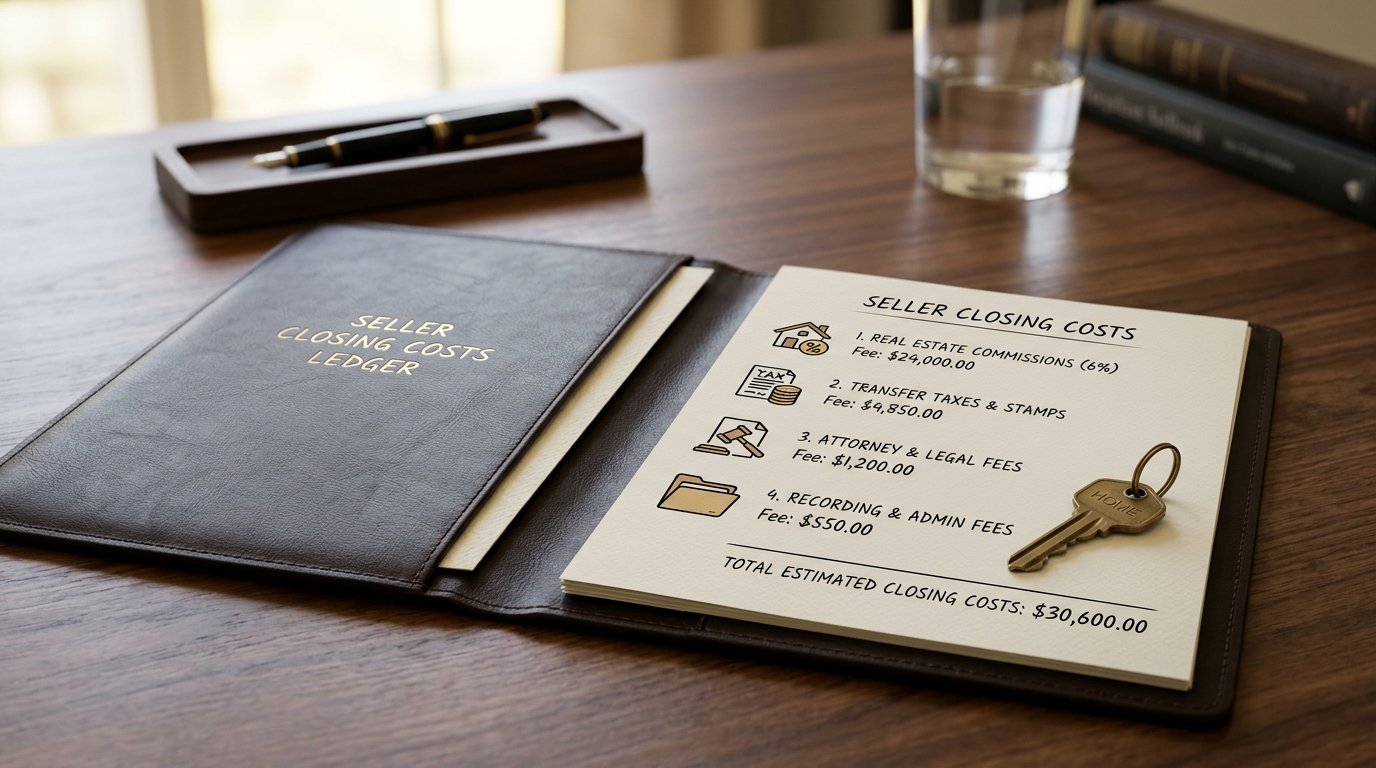
Quick Answer: How Much Do Sellers Pay at Closing?
If you’re selling a home in 2026, here’s what you need to know right now:
Total seller closing costs typically run 6% to 10% of the sale price when you include real estate agent commissions. On a median-priced $362,000 home, that’s **$28,960 to $36,200** coming out of your proceeds.
Without agent commissions — if you’re selling FSBO or negotiating differently — seller closing costs drop to about 1% to 3% of the sale price.
The good news? Most of these fees are simply deducted from your sale proceeds. You won’t need to bring a check to closing unless you owe more on your mortgage than the home is worth — a situation called being “underwater.”
Key fact: Transfer taxes, one of the biggest variables, range from $0 in Texas to over $11,000 in Seattle on a median-priced home. Location matters massively.
Understanding Seller Closing Costs: What You Actually Pay
Selling a home comes with a long list of fees. Some go to professionals who help you close the deal. Others are taxes charged by your state or county. A few are negotiable costs you might agree to cover for the buyer.
The most important thing to know: closing costs are different from the total cost to sell your home. Closing costs are just the fees paid at the closing table. The total cost also includes things like repairs, staging, moving expenses, and your mortgage payoff.
In this guide, we’ll walk through every single fee sellers typically pay, show you real dollar examples, and give you practical tips to reduce what you owe.
Complete Seller Closing Cost Breakdown
Here’s a quick reference table showing the most common seller closing costs. We’ll explain each one in detail below.
| Fee Type | Typical Cost | Who Pays? | Negotiable? |
| Real Estate Agent Commissions | 5% – 6% of sale price | Seller | ✅ Yes — always negotiable |
| Transfer Taxes | 0% – 2.5% of sale price | Seller in most states | ❌ No — set by government |
| Title Insurance (Owner’s Policy) | ~0.5% – 1% of sale price | Seller in many markets | ✅ Shop around |
| Escrow / Settlement Fees | $200 – $2,500 | Split or seller | ✅ Shop around |
| Prorated Property Taxes | Varies by closing date | Seller | ❌ No — based on timing |
| HOA Transfer Fees | $100 – $500+ | Seller | ✅ Negotiable |
| Recording Fees | $39 – $150 | Seller or buyer | ❌ No — government fee |
| Attorney Fees | $500 – $1,500+ | Varies by state | ✅ Shop around |
| Seller Concessions | 1% – 3% of sale price | Seller | ✅ Negotiated |
1. Real Estate Agent Commissions — The Biggest Cost (5% – 6%)
This is by far the largest expense you’ll face as a seller. Historically, agent commissions have totaled 5% to 6% of the sale price, split between your listing agent and the buyer’s agent.
What that looks like in dollars:
- On a $300,000 home: $15,000 to $18,000
- On a $400,000 home: $20,000 to $24,000
- On a $500,000 home: $25,000 to $30,000
Key fact: The average listing agent fee in the U.S. is 2.88%, and the average buyer’s agent fee is 2.82% as of 2026.
What Changed After the NAR Settlement?
In August 2024, a major legal settlement changed how real estate commissions work. The National Association of Realtors agreed to eliminate rules that required sellers to offer compensation to buyer’s agents through the MLS.
What this means for you:
- Commission is now more negotiable than ever. You’re no longer required to offer a specific commission to the buyer’s agent.
- Buyers now sign written agreements with their agents before touring homes, specifying what they’ll pay their agent.
- In practice, many sellers still offer to cover the buyer’s agent commission to make their home more competitive and attract more buyers.
Tip: Talk to your listing agent about commission structure before signing any agreement. If you’re also buying a home with the same agent, use that as leverage to negotiate a lower rate. Some sellers also negotiate lower commissions when selling a high-value property or in a hot market.
2. Transfer Taxes — The Surprise That Varies by Location (0% – 2.5%)
Transfer taxes are government fees charged when ownership of a property changes hands. They’re also called documentary stamp taxes, deed transfer taxes, or conveyance taxes.
The amount varies wildly depending on where you live. This is one of the biggest surprises for sellers who assume closing costs are the same everywhere.
Transfer tax examples across U.S. markets (based on median-priced home):
| Metro Area | Transfer Tax Amount |
| Houston, TX | $0 — Texas has no state transfer tax |
| Denver, CO | $597 |
| Nashville, TN | $1,669 |
| New York, NY | $2,853 |
| Boston, MA | $3,613 |
| Los Angeles, CA | $5,748 |
| Washington, DC | $6,076 |
| San Francisco, CA | $10,400 |
| Seattle, WA | $11,058 |
Key fact: Thirteen states, including Texas, Montana, and Alaska, charge no transfer tax at all. Delaware charges roughly 2% of the sale price, while New York City sellers face a combined transfer tax near 1.4% on the seller’s side alone.
What to do: Check with your title company or real estate agent early in the process to understand exactly what transfer taxes will apply in your area. This is not negotiable — it’s set by state and local governments.
3. Title Insurance — Protecting the Buyer’s Ownership (0.5% – 1%)
Title insurance protects the buyer (and possibly their lender) from future ownership claims, liens, or title defects that weren’t found during the title search.
Two types of title insurance:
| Type | Who Pays | What It Covers |
| Owner’s Title Insurance | Seller in many states | Protects the buyer’s ownership rights |
| Lender’s Title Insurance | Buyer | Protects the lender’s interest in the property |
Cost: Owner’s title insurance typically runs around 0.5% of the sale price. Some sources cite an average of 0.31% to 0.67%, depending on location.
Tip: If you’ve lived in the home for only a few years, ask about a “reissue rate.” You might qualify for a reduced title insurance premium if the title was recently searched.
4. Escrow & Settlement Fees ($200 – $2,500)
Escrow fees are charged by the independent third party that handles your closing. This company manages the money exchange, prepares closing documents, coordinates signatures, and handles recording.
What escrow fees cover:
- Document preparation and management
- Notary and courier services
- Wire transfers and funds disbursement
- Legal compliance and verification
Cost: These fees range from $200 to $2,500, depending on location and the complexity of your transaction. In some states, the cost is split 50/50 between buyer and seller. In others, the seller pays the full amount.
Tip: Escrow and title companies set their own prices. Get quotes from at least three providers before choosing one.
5. Prorated Property Taxes — Paying Your Fair Share
Property taxes are paid in arrears — meaning you pay for the time you actually own the home. At closing, you’ll pay your portion of property taxes up to the closing date, and the buyer takes over from there.
How it works:
- Annual property tax bill ÷ 365 days = daily tax amount
- Seller pays for days owned in the tax period
- Buyer pays for days after closing
Example: If your annual property taxes are $6,000 and you close on June 15th, you’ll pay approximately $2,700 for your portion of the year.
Key fact: All 50 states have property taxes, but rates vary significantly. In some states, property taxes are paid twice yearly through an escrow account associated with your mortgage.
6. HOA Fees — Don’t Forget the Community Costs ($100 – $1,000+)
If your home is in a community with a homeowners association, you’ll have additional closing costs.
What you might owe:
- Prorated HOA dues — your portion through the closing date
- HOA transfer fees — charged by the association to transfer ownership
- Estoppel fees — paperwork fees from the HOA
Cost: The average HOA fee was nearly $200 per month according to the 2021 U.S. Census, ranging from $100 to $1,000+ depending on amenities. Transfer fees vary by community.
Tip: Review your HOA’s rules and regulations early to understand what fees apply. Your HOA can provide a statement of what you’ll owe at closing.
7. Seller Concessions — The Negotiation Tool (1% – 3%)
Seller concessions are costs you agree to cover for the buyer to close the deal. This is also called a seller assist, seller credit, or closing cost credit.
Common concessions:
- Paying a portion of the buyer’s closing costs
- Offering a repair credit instead of making repairs
- Covering the buyer’s agent commission
- Buying down the buyer’s mortgage rate
Cost: Concessions typically range from 1% to 3% of the sale price. They’re deducted from your proceeds at closing.
Key fact: There are limits on how much you can offer as a concession, depending on the buyer’s loan type:
- Conventional loans: 3% to 9% depending on down payment size
- FHA loans: Up to 6%
- VA loans: Up to 4%
- USDA loans: Up to 6%
When to offer concessions: They’re most common in buyer’s markets, when there are more homes for sale than buyers. They can also help close a deal when inspection issues arise.
8. Attorney Fees — Required in Some States ($500 – $1,500+)
Some states require a real estate attorney to handle the closing. In other states, it’s optional.
Where attorneys are typically required: Many East Coast states, including New York, New Jersey, Connecticut, and Delaware.
Cost: Attorney fees range from $500 to $1,500+, or $150 to $350 per hour.
Tip: Even if your state doesn’t require an attorney, hiring one can be helpful for complex transactions, distressed properties, or inherited real estate.
9. Recording Fees ($39 – $150)
Recording fees are government charges to officially record the deed and mortgage information in county public records.
Cost: These small fees typically run $39 to $150, varying by county.
How to Calculate Your Seller Net Proceeds
Your net proceeds are what you actually walk away with after all costs are deducted. This is the number that matters most.
The formula:
text
Sale Price
– Real Estate Commissions
– Closing Costs (title, escrow, taxes, HOA, attorney, recording)
– Seller Concessions
– Mortgage Payoff (including prepayment penalties)
– (Other liens, second mortgages, HELOCs)
= SELLER NET PROCEEDS
Example calculation — $400,000 home sale:
| Line Item | Amount |
| Sale Price | $400,000 |
| Agent Commissions (5%) | -$20,000 |
| Transfer Tax | -$5,000 |
| Title Insurance (0.5%) | -$2,000 |
| Escrow Fees | -$1,200 |
| Prorated Taxes | -$2,500 |
| Seller Concessions | -$8,000 |
| Mortgage Payoff | -$250,000 |
| NET PROCEEDS | $111,300 |
Key fact: Under IRS rules, single filers can exclude up to $250,000 of capital gains from home sale profits, and married couples can exclude up to $500,000 if they’ve lived in the home for at least 2 of the previous 5 years.
How to Reduce Your Seller Closing Costs
Here are practical strategies to keep more money in your pocket:
- Negotiate Agent Commissions
Commission is always negotiable. Ask your agent for a reduced rate if you’re also buying a home with them, selling a high-value property, or have other business to offer. - Shop Title and Escrow Companies
Title and escrow companies set their own prices. Get quotes from at least three providers and compare. - Request a Title Insurance Reissue Rate
If you’ve owned the home for only a few years, ask about a reissue rate. This can save you 40% or more on title insurance. - Consider FSBO — Carefully
Selling For Sale By Owner eliminates agent commissions. But weigh the trade-offs: FSBO homes often sell for less, take longer, and require more work from you. - Be Strategic With Concessions
Only offer concessions when necessary. Understand the buyer’s loan limits so you don’t over-offer. Sometimes a repair credit is cheaper than making the actual repairs. - Time Your Closing Strategically
Closing later in the year might reduce your prorated tax payment. Talk to your agent about timing.
Seller vs. Buyer Closing Costs: Who Pays What?
To avoid confusion, here’s a quick comparison:
| Cost Category | Seller | Buyer |
| Agent Commissions | ✅ Usually | ⚠️ Negotiated |
| Transfer Taxes | ✅ Typically | ❌ Rarely |
| Owner’s Title Insurance | ✅ In many states | ❌ |
| Lender’s Title Insurance | ❌ | ✅ |
| Escrow Fees | ✅ Split | ✅ Split |
| Prorated Taxes | ✅ Through closing | ✅ After closing |
| Loan Origination Fees | ❌ | ✅ |
| Appraisal Fees | ❌ | ✅ |
| HOA Fees | ✅ Through closing | ✅ After closing |
Remember: Local customs vary. In some regions, the buyer pays more of these costs. Always confirm with your agent or title company.
Frequently Asked Questions About Seller Closing Costs
Do sellers usually pay closing costs?
Yes, sellers typically pay 6% to 10% of the sale price in closing costs, including agent commissions. Most fees are deducted from your sale proceeds, not paid out of pocket.
Can seller closing costs be negotiated?
Yes. Agent commissions, escrow fees, title fees, and concessions are all negotiable. Government taxes and recording fees are not.
What is the biggest closing cost for sellers?
Real estate agent commissions — typically 5% to 6% of the sale price — are the largest single expense.
Do I have to pay the buyer’s agent commission?
Not automatically. Since the August 2024 NAR settlement, buyers can negotiate their own agent compensation. Many sellers still choose to cover it to attract buyers, but it’s now a negotiable item.
What are seller concessions?
Concessions are costs you agree to cover for the buyer to close the deal — like paying some of their closing costs or offering a repair credit. They typically run 1% to 3% of the sale price.
Do I have to bring cash to closing as a seller?
Usually no. Most closing costs are deducted from your proceeds. You’d only need to bring cash if you’re “underwater” — owing more on your mortgage than the home is worth.
What factors affect how much a seller pays in closing costs?
Location has the biggest impact — transfer taxes range from 0% in states like Texas to over 2% in states like Delaware. Your sale price, whether you offer concessions, and how you negotiate commissions also play a role.
What is a seller’s net sheet?
A seller’s net sheet is a document that estimates all your costs and shows your expected proceeds from the sale. Your agent or title company can provide one.
What’s the difference between closing costs and total cost to sell?
Closing costs are just the fees paid at closing (title, escrow, taxes). Total cost to sell also includes agent commissions, repairs, staging, moving, and your mortgage payoff.
How do I estimate my net proceeds?
Start with your sale price, subtract your agent commissions, closing costs, concessions, and mortgage payoff. The remaining amount is your net proceeds.
Final Takeaways for Sellers
- Plan for 6% to 10% of your sale price in total closing costs including commissions
- Commissions are your biggest expense — and they’re negotiable
- Location is everything — transfer taxes range from $0 to over $11,000 depending on where you live
- Most fees are deducted from proceeds — you usually won’t need to bring cash to closing
- You can reduce costs by shopping title/escrow, requesting reissue rates, and negotiating commissions
- Concessions are common (1% to 3%) but have loan limits
- Your net proceeds are what matter most — calculate them before listing
Want a Personalized Seller Closing Cost Estimate?
At PayAtClosingRealEstateLeads.us, we help sellers understand exactly what they’ll pay at closing and how to maximize their net proceeds. Because closing costs vary significantly based on your location, sale price, and specific circumstances, we provide customized estimates tailored to your situation.
Contact our team today for a free, personalized seller closing cost analysis. We’ll walk you through every fee, show you where you can save, and help you plan for a smooth closing.
Call us or visit PayAtClosingRealEstateLeads.us to get started.
Disclaimer: This guide is for informational purposes only. Closing costs vary by state, county, and transaction specifics. Always consult with your real estate agent, title company, or attorney for costs specific to your situation.