
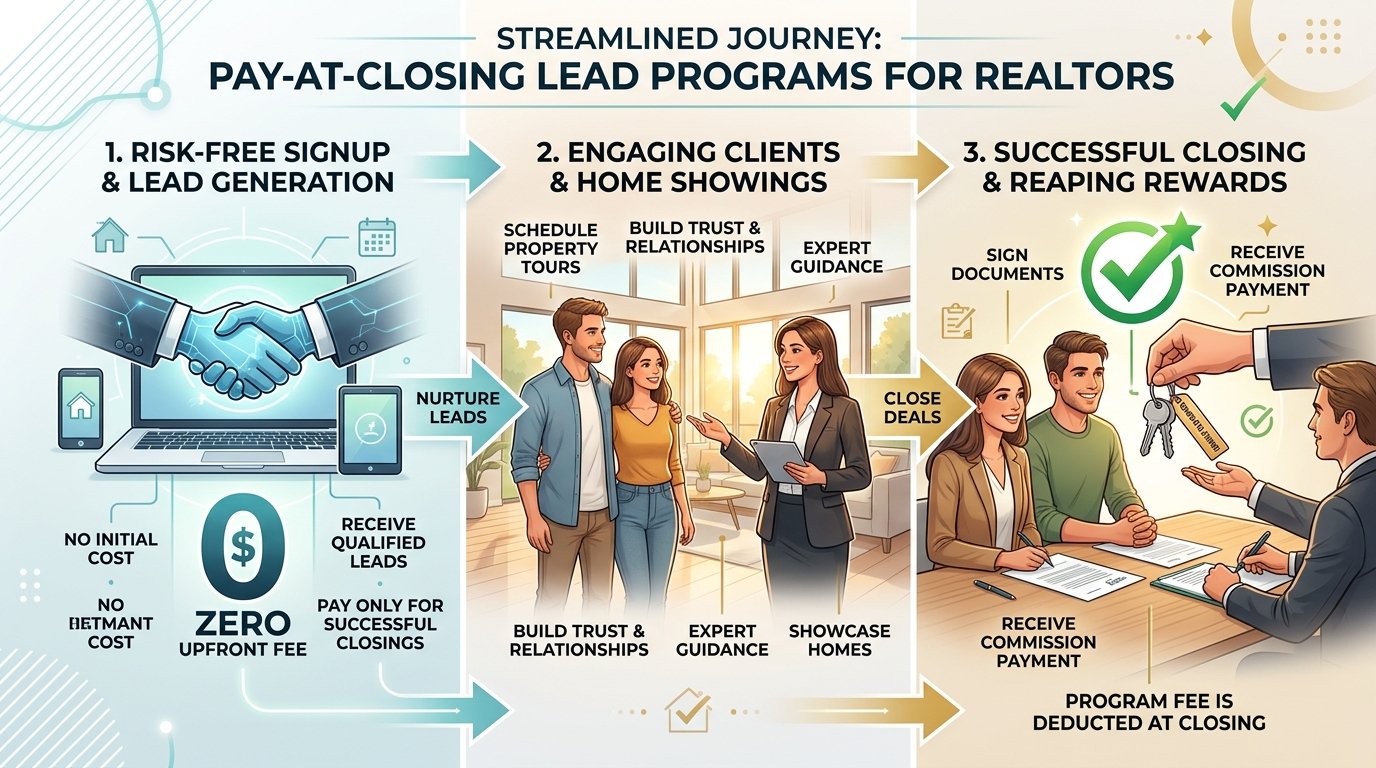
What Are Pay At Closing Lead Programs?
Pay at closing lead programs are performance-based real estate lead generation services where agents pay a referral fee—typically 25% to 40% of their gross commission—only when a deal successfully closes. You get access to pre-screened buyers and sellers with no upfront cost, but you sacrifice a significant portion of your commission and some control over your business. For a $500,000 home at 3% commission ($15,000), a 35% referral fee means paying $5,250** to the provider, leaving you with **$9,750 before broker splits. Major providers include payatclosingrealestateleads.us, Opcity (ReadyConnect Concierge), Zillow Flex, HomeLight, and UpNest.
Introduction: Why Pay At Closing Leads Are Everywhere Right Now
If you are a real estate agent, you have probably seen the ads. “Get leads with no upfront cost!” “Pay only when you close!” “Zero risk lead generation!”
It sounds like the perfect solution, right? You get a steady stream of buyers and sellers without spending a dime on advertising, learning complicated online marketing, or wasting money on leads that never convert.
Pay at closing lead programs have exploded in popularity for exactly these reasons. They offer a low-risk way for agents to fill their pipeline, especially those who are new to the business or working with a tight budget. But here is the thing—there is always a catch.
Many agents who jump into these programs soon discover hidden costs, frustrating restrictions, and a “second boss” who dictates how they run their business. The question is not just “how do these programs work?” but “are they actually worth it for your real estate career?”
In this complete guide, we will break down everything you need to know about pay at closing lead programs. We will cover how they work, the real costs involved, the top providers, and—most importantly—whether you should use them or build your own lead generation system instead.
Chapter 1: How Pay At Closing Lead Programs Work
What Does “Pay at Closing” Actually Mean?
The concept is simple. A lead generation company runs marketing campaigns, captures interested buyers and sellers, and routes those leads to real estate agents like you. Instead of paying upfront for advertising or a monthly subscription, you agree to pay the company a referral fee from your commission—but only if the lead actually closes.
This model is also called:
- Performance-based leads
- Success-based leads
- Commission-based leads
- Pay-per-close leads
- Real estate referral leads
The key difference between PAC leads and traditional lead generation is the risk transfer. The lead provider takes on the financial risk of running ads and marketing. You only pay when you get paid.
The Step-by-Step Process
Here is how most pay at closing programs work in practice:
- You Sign Up: You create a profile with a PAC provider like payatclosingrealestateleads.us, Opcity, HomeLight, or Zillow Flex. You provide details about your license, experience, and preferred markets.
- The Provider Generates Leads: The company runs online ads, SEO, social media campaigns, and sometimes even call centers to attract potential buyers and sellers. They may use AI-powered platforms, predictive analytics, or partnerships with major websites like Realtor.com.
- Leads Are Qualified: Before sending you a lead, the provider usually vets them. This might mean a phone call to confirm they are serious, checking their budget, or verifying their timeline. The goal is to send you “qualified leads” rather than random internet tire-kickers.
- You Receive the Lead: Leads are often delivered via text message, app alert, or email. Some programs use “live transfer,” where a call center agent connects you directly to the lead on the phone.
- You Must Respond Quickly: This is crucial. Many PAC programs send the same lead to multiple agents. The agent who responds first—often within seconds—gets the chance to work with that client. If you are slow, you lose the opportunity.
- You Work the Lead: You treat the lead like any other client. You show homes, answer questions, negotiate offers, and guide them through the buying or selling process.
- You Pay Only If You Close: If the lead does not buy or sell with you, you owe nothing. But if you successfully close the deal, you pay the referral fee. Some programs also require a fee if that client comes back to you for a future transaction within a certain time period.
Fact 1: The referral fee is almost always calculated as a percentage of the gross commission, not the net commission after broker splits. This means you pay the fee before your brokerage takes their cut, which significantly reduces your take-home pay.
Chapter 2: Why Agents Are Attracted to PAC Programs
The Emotional Appeal
Let us be honest. The real estate industry is competitive. Generating leads is hard work. Marketing is expensive, and there is no guarantee of results.
PAC programs tap directly into the fears and frustrations that agents face every day:
- Fear of wasting money: What if you spend $1,000 on Facebook ads and get zero leads?
- Fear of not having enough clients: What if you go months without a closing?
- Frustration with complex marketing: Who has time to learn Google Ads, SEO, and social media algorithms while also showing homes and negotiating contracts?
PAC programs promise to solve all of these problems. “No upfront cost” sounds like a dream. “Pay only when you close” sounds like a no-brainer.
Who Are Pay At Closing Leads Best For?
PAC programs are not for everyone. Based on extensive agent feedback and industry analysis, these programs work best for:
New Agents
If you just got your license, you probably do not have a big database, a strong online presence, or a marketing budget. PAC leads give you a way to get experience, build your skills, and close a few deals quickly. Think of it as “training wheels” for your real estate business.
Agents with Tight Budgets
If you cannot afford to spend $1,000 to $3,000 per month on Google Ads or Facebook Ads, PAC programs offer an alternative. You do not pay anything until you close a deal, which helps with cash flow.
Teams Looking for Quick Volume
Some real estate teams use PAC leads to generate extra transactions for new agents on their team while they build their own lead generation systems. It is a way to keep everyone busy and producing.
Fact 2: Many top producers and industry experts recommend treating PAC leads as a short-term strategy, not a long-term business plan. As Chris Morgan, VP of Sales at Real Geeks, put it, PAC leads can provide “short-term feel-good transactions” but do not build long-term business equity.
Chapter 3: The Hidden Costs of Pay At Closing Lead Programs
Here is where we get real. PAC programs may not cost you anything upfront, but they are far from free. In fact, they can be incredibly expensive over time.
Financial Costs: How Much You Really Pay
Let us break down the numbers with a real example.
Scenario: You close a $500,000 home with a 3% commission.
- Gross Commission: $500,000 x 3% = $15,000
- PAC Referral Fee (35%): $15,000 x 35% = $5,250
- Your Commission Before Broker Split: $15,000 – $5,250 = $9,750
Now let us compare that to generating your own leads through PPC advertising.
- Annual Marketing Investment: $12,000 (for your website and ads)
- Leads Generated per Year: Approximately 300
- Conversion Rate: 1% (average for online real estate leads)
- Closings per Year: 300 x 1% = 3
- Marketing Cost per Closing: $12,000 / 3 = $4,000
- Your Net Commission per Closing: $15,000 – $4,000 = $11,000
The Difference: With PAC, you keep $9,750** per deal. With owned leads, you keep **$11,000 per deal. That is a difference of $1,250 per closing.
Now imagine you close 10 deals in a year using PAC leads. You would pay $52,500** in referral fees. With owned leads, you would pay approximately **$40,000 in marketing costs. That is a $12,500 difference in your pocket.
Fact 3: Some PAC providers charge even higher fees. Linkhome, for example, collects a “negotiated share of earned commission” from agents, which can be significantly more than 35% depending on the market and the deal.
The Non-Financial Costs: Your Freedom and Independence
Money is not the only thing you lose with PAC programs. You also lose a significant amount of control over your business.
Loss of Autonomy
Many PAC providers require you to attend mandatory weekly or monthly accountability calls with their managers. They track your response times, your conversion rates, and your follow-up activities. If you do not meet their performance standards, they reduce your lead flow or kick you out of the program entirely.
As one agent put it, “You end up with almost a second boss, even though you got into real estate for independence.”
Working Outside Your Farm Area
PAC programs often send leads based on geography, but they do not always match your chosen farm area. You might end up working with clients who are far from your office, outside your expertise, or in neighborhoods you do not know well.
Unrealistic Price Points
Some leads are simply not qualified. They want a $300,000 home in a market where the average price is $600,000. They are “tire-kickers” who waste your time and energy.
Shared Leads
Many PAC programs send the same lead to multiple agents. This creates a race to the bottom. The agent who responds fastest gets the lead, regardless of their expertise or ability to serve the client.
Who Owns the Lead? The Data Problem
This is one of the most overlooked issues with PAC programs.
When you work a PAC lead, you do not own that lead. The vendor does. The lead lives in their CRM, not yours.
If you leave the program, you lose access to every lead you have ever worked with. Even the ones you spent months nurturing. Even the ones who promised to refer their friends and family.
Some providers have changed their terms of service to treat contacts as “mutual customers” shared with their other services. This raises serious questions about data ownership and client privacy.
Fact 4: NAR data shows that the average REALTOR® gets 20% of their business from past clients and 21% from referrals. That repeat and referral business only works if you control the relationship and the contact information. PAC programs take that away from you.
Chapter 4: Pay At Closing vs. Owned Lead Generation
The “Rent vs. Own” Metaphor
Think of it this way:
- Pay at closing leads = renting a house. You get to live there, but you do not build equity. When you move out, you have nothing to show for it.
- Owned lead generation = buying a house. You pay more upfront, but you build equity over time. When you sell, you get your money back and then some.
Here is a side-by-side comparison to help you decide.
| Feature | Pay At Closing Leads | Owned Lead Generation |
| Cost Model | Variable; 25-40% referral fee per closing | Fixed; monthly ad spend, website, and CRM costs |
| Lead Ownership | Vendor owns the lead and data | You own the lead and data |
| Control | Low; vendor dictates area, price point, and follow-up rules | High; you control everything |
| Independence | “Second boss” with mandatory meetings and rules | True independence and freedom |
| Business Value | No asset built; pipeline is rented | Builds a sellable asset (database + brand) |
| Long-Term ROI | Negative; high costs do not compound | Positive; costs decrease, leads and database grow |
Why Owned Leads Build a Better Business
When you generate your own leads through SEO, PPC, social media, and your own website, you are building something that lasts.
- Your database grows every year. Each new client, each new referral, each new contact adds to your list of past clients and warm prospects.
- Your brand becomes stronger. People recognize your name, trust your expertise, and come to you first when they are ready to buy or sell.
- Your business becomes more valuable. If you ever want to sell your real estate business, the buyer is mostly paying for your database, your brand, and your systems. PAC programs give you none of that.
Fact 5: Top real estate teams get to “stable, high-margin businesses” by owning their lead generation. They are not chasing low-margin transactions. They are building something that can be sold or passed down.
Chapter 5: Top Pay At Closing Lead Providers in 2026
If you decide that PAC leads are right for your situation, you need to choose the right provider. Here is a comprehensive breakdown of the major players, including their fee structures, pros, and cons.
1. Pay at closing real estateleads.us
Fee Structure: Pricing varies based on location, market, and specific requirements.
Key Features: Comprehensive provider comparison, transparent reviews, and agent-focused resources.
Best For: Agents who want to research and compare PAC programs before committing.
Why Choose Us: We help you make an informed decision with real agent feedback, detailed provider breakdowns, and zero bias. Contact our team to learn about current pricing and available options in your market.
2. Opcity (Realtor.com / ReadyConnect Concierge)
Fee Structure: 30-35% of gross commission (30% for homes up to $150,000, 35% for homes above).
Key Features: Phone-verified leads; leads are vetted by a call center before being sent to agents.
Pros: No upfront cost; high lead volume; leads are pre-screened.
Cons: Highly competitive; agents must respond in seconds; lead quality can be mixed; high referral fee.
Agent Feedback: Many agents have reported success with Opcity, but they emphasize that you need to manage leads efficiently and work through many low-quality leads to find the valuable few.
3. Zillow Flex
Fee Structure: 15-40% of commission, depending on lead quality and market.
Key Features: Only available to top-performing Premier Agent customers; performance-based entry.
Pros: Access to Zillow’s massive audience and high-intent leads.
Cons: High costs; variable lead quality; high-pressure sales tactics from Zillow; agents can be kicked out for low conversion rates.
Agent Feedback: Some agents have significantly boosted their income with Zillow Flex, but others complain about the high costs and questionable lead quality.
4. HomeLight
Fee Structure: Approximately 33% referral fee.
Key Features: Data-driven matching; often focused on seller leads.
Pros: Easy setup; no advertising costs; data-driven.
Cons: Must maintain a solid closing history; high competition; significant commission cut.
Agent Feedback: Some agents have closed deals worth over $5 million within 18 months using HomeLight, but others report low conversion rates and leads that are more inclined to negotiate down commissions.
5. UpNest
Fee Structure: 30% referral fee.
Key Features: Agents compete for leads by submitting proposals and lower commission rates.
Pros: Performance-based; popular with price-conscious sellers.
Cons: “Race to the bottom” on commissions; agents must have 3 years of experience and six transactions in 12 months; the referral period can extend to 24 months for any transaction with the client.
Agent Feedback: Many agents complain that leads seem to prioritize low commission rates above all else.
6. Clever
Fee Structure: 1.5% of home’s sale price or $3,000 minimum for homes under $350,000.
Key Features: Pre-negotiated lower commission model.
Pros: Transparent pricing; connects sellers with full-service local agents.
Cons: Some agents report that the leads are more price-sensitive than quality-focused.
7. Agent Pronto
Fee Structure: 25-35% referral fee.
Key Features: Leads are sent via text messages for quick claiming.
Pros: Immediate notification; no upfront cost.
Cons: Must respond quickly; referral fee is on the higher end.
8. Rocket Homes
Fee Structure: 1% of home value or 25% of commission.
Key Features: Connects agents with pre-approved buyers from the Rocket Mortgage ecosystem.
Pros: Access to qualified, pre-approved buyers; strong brand recognition.
Cons: Referral fee can add up quickly on high-priced homes.
9. Linkhome
Fee Structure: Negotiated share of earned commission.
Key Features: AI-powered platform; expanding ecosystem for homebuilders, lenders, and agents.
Pros: Flexible pricing; innovative technology.
Cons: Newer player; less established track record.
10. BuildersUpdate
Fee Structure: $750 flat fee per closing.
Key Features: Specifically designed for homebuilders; “pay upon performance” model.
Pros: Flat fee, not a percentage; designed for homebuilders.
Cons: Only applicable to homebuilders, not general agents.
Chapter 6: Are Pay At Closing Leads Legal?
This is a question that many agents do not think to ask. But it is an important one.
The RESPA Factor
The Real Estate Settlement Procedures Act (RESPA) is a federal law that prohibits giving or receiving a “kickback” or “thing of value” for referrals of settlement service business. This includes real estate transactions.
Section 8 of RESPA specifically bans referral fees between settlement service providers. The only exception is the “broker-to-broker referral exemption,” which allows licensed real estate brokers to refer business to each other.
The Controversy
There is a growing legal and ethical debate about whether many PAC programs actually violate RESPA. Critics argue that these platforms are not legitimate broker-to-broker referrals but rather illegal kickbacks disguised as referral fees.
One industry watchdog has alleged that Zillow Flex has collected an estimated “$5 billion in kickbacks” since 2018. Similar criticisms have been leveled against Opcity, HomeLight, UpNest, Clever, and Rocket Homes.
What This Means for You
While these programs continue to operate, it is important to understand the legal gray area. Some states and local associations have stricter interpretations of RESPA than others.
If you are considering a PAC program, do your due diligence. Ask the provider about their legal structure. Consult with your broker or a real estate attorney. Make sure you understand your obligations and liabilities.
Chapter 7: How to Choose the Right PAC Program
If you decide that PAC leads are right for you, here is a step-by-step framework to evaluate your options.
Questions to Ask Every PAC Provider
- What is the exact referral fee percentage? Is it based on the gross commission or the net commission?
- What is the referral period? How long do I owe fees on this client if they come back for a future transaction?
- Are leads exclusive or shared with multiple agents? If they are shared, how many agents will I compete with?
- How are leads qualified? Are they vetted by a call center? Are they pre-approved for a mortgage?
- What are the follow-up rules and performance metrics? Will I be penalized if I do not meet their standards?
- Who owns the lead data? What happens to my leads and relationships if I leave the program?
- What is the average conversion rate for other agents in my area? Ask for specific numbers.
- Are there any hidden fees? Are there setup fees, cancellation fees, or other charges?
Red Flags to Watch For
- Vague or confusing fee structures. If they cannot explain the fees clearly, walk away.
- Unrealistic promises. “You will close 10 deals in your first month” is a lie.
- Long-term contracts. You should be able to leave the program if it is not working for you.
- No transparency on lead quality. If they cannot tell you how leads are qualified, they are not qualified leads.
Chapter 8: Success Strategies for PAC Leads
If you are going to use PAC leads, you need to maximize your chances of success.
Tip 1: Prioritize Speed to Lead
With most PAC programs, leads are sent to multiple agents. The agent who responds first gets the best chance to work with that client.
Set up your phone to receive alerts immediately. Keep your CRM open and ready. If a lead comes in at 8 PM on a Saturday, respond immediately. That is what the top performers do.
Tip 2: Focus on Problem-Solving, Not Just the Sale
As Chris Morgan from Real Geeks advises, your number one job is to “solve a problem” for the lead. Understand their journey and needs. Help them navigate the process.
Do not expect an immediate showing or closing. Online leads often convert on an 8-to-12 month timeline. Build the relationship, provide value, and stay top of mind.
Tip 3: Have a Follow-Up System
PAC leads require consistent, systematic follow-up. Use a CRM to track every interaction. Set tasks and reminders. If you do not have a follow-up system, you will lose leads to agents who do.
Tip 4: Set Realistic Expectations
Not every PAC lead will close. The conversion rate is often low, especially for newer agents. Do not expect to close 50% of your leads. A conversion rate of 1-5% is more realistic.
Tip 5: Treat PAC as a Supplementary Channel
PAC leads should not be your primary strategy. They should be one channel among many. Use them to fill your pipeline while you build your own lead generation systems.
Chapter 9: How to Build Your Own Lead Generation Funnel
If you want to build a sustainable, scalable real estate business, you need to own your lead generation.
Step 1: Claim Your Online Home Base
Start with a professional website. It should include:
- IDX search: Let buyers and sellers search for properties on your site.
- Lead capture forms: Collect contact information from visitors.
- Valuation tools: Provide home value estimates to attract sellers.
- Your brand: Show your unique value proposition and local expertise.
Set up your Google Business Profile. It is free and essential for local SEO.
Step 2: Drive Traffic with PPC and SEO
- Google Ads: Target keywords like “homes for sale in [your city]” and “real estate agent [your city].”
- Facebook Ads: Target specific demographics and interests in your local market.
- SEO: Create content that answers common questions and ranks in search results.
Step 3: Capture and Nurture in Your CRM
Every lead that comes to your website should be captured in your CRM. Use automation to send market reports, home value updates, and educational content.
Build relationships over time. Do not just send generic emails. Personalize your communication based on the lead’s interests and behaviors.
Step 4: Build Your Brand
- Create content that positions you as a local expert.
- Write blog posts about the local market.
- Create videos showing homes and neighborhoods.
- Post on social media consistently.
- Ask for reviews and testimonials.
Step 5: Track and Optimize
Monitor your key metrics:
- Number of leads per month
- Cost per lead
- Conversion rate
- Cost per closing
- ROI
Use this data to optimize your campaigns. Double down on what works and cut what does not.
Chapter 10: Conclusion and Decision Matrix
The Verdict
Pay at closing lead programs are a useful tool for certain situations, but they are not a long-term strategy for building a successful real estate business.
Choose PAC if you are:
- A brand-new agent needing quick wins and experience.
- An agent with a tight budget who cannot afford upfront marketing.
- A team looking for short-term volume while building your own systems.
Choose Owned Lead Generation if you:
- Want to build a sustainable, scalable business.
- Want to maximize your long-term income.
- Want to create a sellable asset.
- Value independence and control over your business.
Final Thought
Treat PAC as one small channel, not your main strategy. The most successful agents use PAC leads to supplement their own lead generation, not replace it.
If you rely only on PAC, you are renting your future. If you build your own funnel, you are building equity.
Ready to Take Control of Your Lead Generation?
Contact our team at payatclosingrealestateleads.us to learn more about PAC programs, compare providers, and find the best fit for your business. Our pricing varies based on location, market, and specific requirements, so reach out for a personalized quote.
Frequently Asked Questions
What does “pay at closing” mean in real estate?
Pay at closing means you only pay a referral fee to the lead provider when a deal successfully closes. If the lead does not result in a closing, you owe nothing.
How much are the fees for pay at closing lead programs?
Fees typically range from 25% to 40% of the gross commission. Some providers charge a flat fee, while others charge a percentage. Pricing varies based on the provider, location, and market. Contact our team at payatclosingrealestateleads.us for current pricing and options.
Are pay at closing lead programs worth it?
It depends on your situation. PAC leads are useful for new agents or those with tight budgets. However, they are expensive in the long run and do not build business equity. For long-term growth, building your own lead generation funnel is usually better.
What are the best pay at closing lead providers?
The top providers include payatclosingrealestateleads.us, Opcity (ReadyConnect Concierge), Zillow Flex, HomeLight, UpNest, Clever, Agent Pronto, and Rocket Homes. The best provider for you depends on your market, experience, and specific goals.
Are pay at closing leads legal?
There is an ongoing legal debate about whether some PAC programs violate RESPA, the federal law that bans referral fees between settlement service providers. While these programs continue to operate, it is important to do your due diligence and consult with your broker or attorney.
How do I convert pay at closing leads?
Speed to lead is critical. Respond immediately when you receive a lead. Focus on solving problems for the lead, not just pushing for a sale. Have a systematic follow-up process and be patient—online leads often convert on an 8-to-12 month timeline.
How do I build my own lead generation system?
Start with a professional website with IDX search, lead capture forms, and valuation tools. Drive traffic with Google Ads, Facebook Ads, and SEO. Capture every lead in your CRM and nurture them with automation. Build your brand with content, videos, and social media.